WASHINGTON (AN) — Mykyta Myronenko was driving a military pick-up truck in September 2024 with three of his fellow soldiers in a Russian occupied territory in Ukraine, when suddenly a landmine went off, blowing up the truck and catapulting the soldiers onto the street.
“The first minute, I thought I died,” Myronenko, a senior sergeant, said.
The Ukrainian was lying unconscious on the ground when his uninjured brothers in arms rushed to help him. “You lost your right leg,” they told him.

Myronenko is one of tens of thousands of Ukrainians who have suffered limb loss since the full-scale invasion by Russia in February 2022. Despite a huge investment by the government of Ukraine, nonprofit groups in the U.S. continue to fill in the gaps to supply prosthetics to those who need it, fueling advancements in prosthetic technology production in Ukraine.
Since launching its full-scale invasion, Russia has repeatedly launched drone and missile strikes, leaving an estimated 100,000 Ukrainians with limb loss, according to unofficial sources.
In the first six months of 2025, the Ukrainian government provided more than 208,000 prosthetic products to more than 56,000 Ukrainians, costing the government a total of $53.8 million, according to the Ukrainian government portal.
While the Ukrainian Ministry of Public Health has funded many limb replacements, 59,000 Ukrainians still need prosthetics, according to the Ministry of Social Policy in Ukraine. Some amputees, like Myronenko, needed support from nonprofit organizations such as the Protez Foundation.
The World Health Organization has identified rehabilitation as one of the country's most urgent health priorities. In its 2026 Ukraine Health Emergency Appeal, WHO said more than 100,000 amputations have been performed since the start of the war, while rehabilitation remains severely limited, with only 4% of hospitals providing inpatient rehabilitation and just 3% offering assistive technologies such as prosthetics and corrective devices.
WHO says expanding rehabilitation services is now a central component of Ukraine's emergency health response. In May, WHO’s governing body, the World Health Assembly called for expanded international support for rehabilitation, prosthetics and assistive technologies as part of Ukraine's long-term health system recovery.
The International Committee of the Red Cross has also worked with Ukraine’s Ministry of Health and Kharkiv University Clinic to expand physical rehabilitation services near the front line. The partnership includes a mobile clinic providing prosthetics, orthotics, physical therapy and mental health support, as well as a permanent rehabilitation wing and prosthetics laboratory under construction at the university clinic.
The program is intended eventually to be transferred fully to the Ukrainian clinic, the ICRC said, strengthening local capacity to provide long-term care.
“Our regular civilian hospitals were filled with warriors, so we needed extra clinics, we needed extra doctors, we needed extra knowledge,” said Anastasiia Sliusarenko, the director of partnerships and development at Protez. “Then we understood that we cannot just be helping these people on the ground in Ukraine. More complicated cases needed to be transferred to the U.S….So we jumped in.”
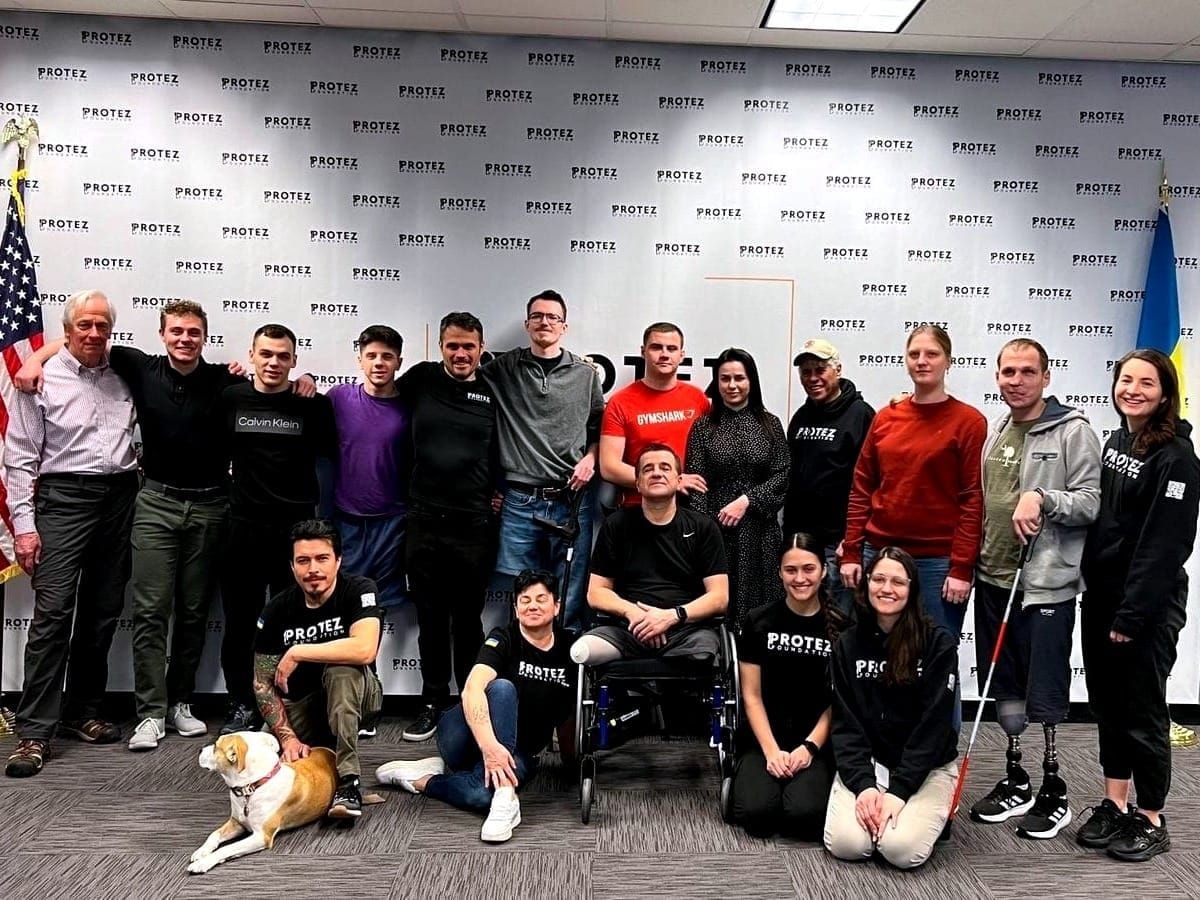
Founded in May 2022, Protez funds the prosthetic installation and rehabilitation of patients in its clinics in Ukraine. Amputees receive prosthetics, physical and psychological therapy by professionals, or personnel educated at their training facility, the Protez Academy. Severe cases are taken to the foundation’s rehabilitation clinic in the U.S.
In 2024, Myronenko traveled to Protez’s headquarters in Oakdale, Minn., where he was fitted with a prosthetic leg. Under Protez’s fully funded program, he lives near the clinic with other Ukrainians who are rehabilitating after losing their limbs, and undergoes intense physical therapy five times a week.
Razom for Ukraine, a U.S.-based donor-funded organization, has also stepped in to provide arm prosthetics to individuals not qualified to receive artificial limbs from the government.
“What we are doing is we are basically catching those who are falling off because of different procedures, and limitations of the current government system,” Iryna Gudyma, the project lead at Razom, said.
By matching patients with prosthetic clinics and rehabilitation centers, Gudyma said Razom is “helping to catch those people who need the hand a lot, but are not those that the government can give those hands to.”
The provision of prosthetics in Ukraine is governed by two regulations. Resolution 321 states that all Ukrainian citizens, both civilians and soldiers, with disabilities qualify for a free, state-funded prosthetics. Resolution 518 covers the provision of free prosthetics for military personnel, with maximum coverage of $48,000 per limb.
Gudyma said that there is a strict bureaucratic process that those seeking assistance need to follow, requiring specific documentation obtained from the site of injury, which a lot of patients have not acquired.
The rehabilitation challenge extends beyond Ukraine. Rising war-related amputations have also forced Russia to triple its rehabilitation budget to 98.16 billion rubles. Yet systemic bottlenecks mean only 54% of lower-limb prosthetic demand is being met, according to a New Lines Magazine analysis published in May. Despite distributing more than 179,000 prosthetic devices, the report found, the continuing influx of wounded patients is straining Russia's rehabilitation capacity.
It is not just Ukrainians who might not qualify to receive prosthetic care by the government, but also foreign soldiers who volunteer to defend the country in the front lines.
Eric Jorgenson, a U.S. citizen, joined the Ukrainian Military Legion in 2022, just months after he was discharged from the Marine Corps. In October of that year, Jorgenson was deployed to the frontlines at Kharkiv, where he was hit by a large explosive projectile.
As an American, Jorgensen did not qualify for Ukrainian government prosthetic programs and at first was at a loss for how he would pay for artificial limbs, which he would need to replace frequently.
“I was just so lost and confused, I didn't know what I was going to do, and how I was going to get prosthetics for the rest of my life,” he said.
To his relief, he was accepted to receive care by the Protez Foundation a little over a year after his injury. Later, the U.S. Veterans Administration agreed to take on his care.
“The fact that Eric said that he got lucky, we want to change that. We don't want people to feel like they have to be lucky to get on the list,” Sliusarenko said.

Developing prosthetic care pushed for Ukrainian innovation
As these organizations are trying to keep up with demand, the unprecedented volume of amputees has also fostered innovation in the prosthetic industry.
Organizations such as Unbroken and its Prosthetics and Orthotics Center continue developing prosthetic technology to meet the needs of soldiers and civilians who have lost limbs in the war.
The United Nations Industrial Development Organization is also working with Ukrainian ministries to expand the country's capacity to produce 3D-printed prosthetics. The initiative provides equipment and advanced training in digital modeling for Ukrainian prosthetists, with the aim of producing customized lower-limb prosthetics locally while also creating vocational opportunities for people with disabilities.
Vladyslav Sikhovsky, a prosthetics specialist at Unbroken, said that the prosthetic manufacturing and rehabilitation center had the opportunity to innovate prosthetic technology, “because we have a lot of patients, a lot of extreme traumas. We work with that, and that’s how we gain the experience.”
Sikhovsky added the organization has grown from providing 450 prosthetics in 2025, to manufacturing up to 50 prosthetics a month.
“It's nonstop. We have specialists going for training back and forth, or getting education. Every day, it's a nonstop job for us,” Sikhovsky said.
The Ukrainian government has forged partnerships with prosthetic manufacturers and partnered with Esper Bionics, a New York-based organization that manufactures and innovates advanced prosthetic devices in Ukraine. Esper installs bionic hands, and has provided 65 prosthetic devices for Ukrainian soldiers since the start of the war.
“Bionic hands are the reality, not the future,” Lidiia Sanyk, the Ukraine’s lead at Esper Bionics said.
Esper, which has offices in Kyiv and Lviv, has developed and manufactured new prosthetic technologies, including waterproof bionic hand systems with customized fitting. They are now preparing to launch MARS, a sensor hub that uses artificial intelligence to translate neurological signals and deliver precise movements for prosthetic hands.
While Esper Bionics focused their product primarily on the U.S. market before 2022, the war increased the demand in Ukraine. Now, most of their prosthetics are distributed in Ukraine. They continue to supply their cutting-edge technology across the global market, exporting roughly 30% of their bionics.
Through technological advancement, Esper works to keep up with the number of high-level amputated soldiers who are “dreaming to be absolutely independent and regain the possibility to join the service,” Sanyk said.
Myronenko was a military medic even before Russia invaded, and he yearns to return to the Ukrainian military. Even in the immediate aftermath of his accident, while he was still in Ukraine, Myronenko used his engineering skills to manufacture drone parts with his 3D printer for the Ukrainian military.
“I actually ran away from the hospital back home, and I have a printer at home, and I started printing little parts that my brothers in arms needed,” Myronenko said.
Now, as he works towards recovery thousands of miles away from Ukraine, Myronenko constantly thinks about returning.
“I want to go back because I didn't do everything I wanted to do. I'm not done yet. I want to do more,” Myronenko said. “My guys are waiting for me.”