Skip to content

Silent plea with teddy bears echoes U.N. findings on Ukrainian children

Two Ukrainian advocacy groups are raising awareness for children abducted from Ukraine by Russia during the war.

Advocacy groups have worked with the U.S government and international organizations to keep the 20,000 children in the news and peace talks.
Advocacy groups have worked with the U.S government and international organizations to keep the 20,000 children in the news and peace talks. (Rebecka Pieder/Medill News Service)

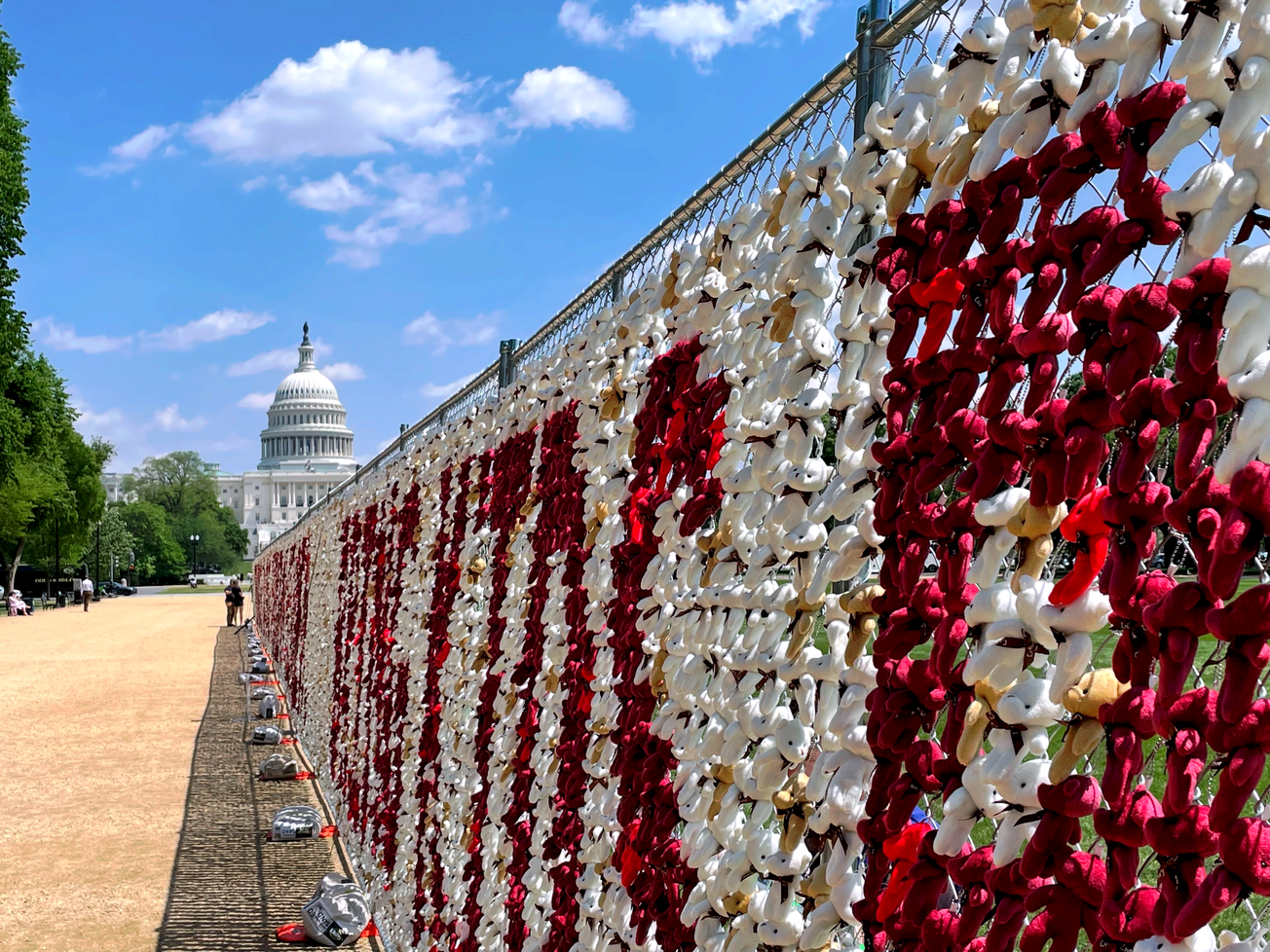
WASHINGTON (AN) — Exactly 20,000 tiny teddy bears adorned a fence on the National Mall, each stuffed toy representing one Ukrainian child abducted by Russia since the start of the war.

Created by two Ukrainian advocacy groups, the display near the U.S. Capitol on Thursday was meant to urge the U.S government to prioritize getting the children back from Russia. Advocates called for the issue to remain in the national spotlight and for all children to be sent home.

Hand-sized red, white, beige and purple bears hung on a metal fence with the message: "Putin Abducted 20,000 Ukrainian Children. Bring Kids Back."

“Why teddy bears? It's because kids go to teddy bears for comfort," said Mykola Murskyj, Razom for Ukraine's advocacy director. "It's the universal symbol of the thing that I held onto in my childhood when I was scared."

Murskyj emphasized that the Ukrainian children who have been forcibly abducted by Russia from the occupied territories in Ukraine, including Donetsk and Luhansk, sadly lack that comfort. “We want people to understand that we have kids that are terrified right now,” he said.

"They have been ripped from their parents' arms, shipped off to Russia by train or by bus, and then distributed among families, given different names, given different identities, and these kids have no teddy bear."

Members of the U.N.'s Independent International Commission of Inquiry on Ukraine to the Human Rights Council reported in March they have verified the deportation and transfer of 1,205 children from Russian-occupied areas in Ukraine to Russia or to other occupied areas in Ukraine.

Ukrainian nonprofit Bring Kids Back UA, an initiative of Ukraine’s president, says it has identified around 20,570 records of possible deportation and forced transfer of children by Russia since it launched its full-scale invasion of Ukraine in Feb. 2022.

Citizens and U.S. lawmakers gathered on the National Mall in Washington on April 23, 2026, in support of Ukraine's abducted children. (Rebecka Pieder/Medill News Service)

Bipartisan support for returning abducted Ukrainian children

Russian representatives have previously told the U.N. Committee on the Rights of the Child that children had been “evacuated” from Ukrainian orphanages and care centers for their own safety. The Kremlin has consistently denied allegations of kidnapping.

Sen. Amy Klobuchar, who spoke at Thursday’s event, sponsored the Abducted Ukrainian Children Recovery and Accountability Act, a bipartisan bill to help Ukraine locate, return, and rehabilitate children taken by Russia during its fullscale invasion. The bill was signed into law last year and the U.S. has provided modern technology to track children.

Despite the widespread documentation and bipartisan concern, U.S. President Donald Trump's administration last year moved to eliminate federally supported programs to locate and return these children.

However, Melania Trump, who has been working with the Ukrainian Ambassador Olha Stefanishyna, announced last October they had secured the return of eight children. The first lady said the reunifications resulted from an open channel of communication with the Kremlin.

In March, the U.S. Department of State, in coordination with Congress, allocated $25 million to facilitate the identification, return, and rehabilitation of Ukrainian children and youth.

Sen. Richard Blumenthal, Democrat of Connecticut, also spoke at the event, having traveled to Ukraine 10 times to meet people there. He plans to return in May, and said he will take one of the teddy bears with him.

"I have met the children of Ukraine," he said. "What Putin is doing to tens of thousands of children is a war crime."

The U.N. commission's March report said the "compelling evidence" it obtained, based on interviews with 2,433 people, documentation and open source records, and 27 trips to Ukraine, "has led it to conclude that these acts amount to crimes against humanity and war crimes of deportation and forcible transfer of children."

"From the cases investigated by the commission, 80% of the children have not yet returned," its report noted. "Those who managed to organize returns encountered obstacles, delays, and security risks."

Diplomats on the U.N. Security Council also have individually condemned the cruelty, but collectively the 15-nation panel responsible for maintaining global peace and security has been unable to act on the issue since Russia holds one of its five veto-wielding permanent seats.

By contrast, the International Criminal Court issued its first arrest warrants tied to Russia's war in Ukraine over three years ago, charging Russian President Vladimir Putin and Maria Lvova-Belova, Russia’s commissioner for children’s rights, with war crimes for taking children to Russia from occupied areas of Ukraine.

“Putin is not just trying to take territory and defeat a nation, he’s trying to destroy a people. That is the purpose of abducting children,” Blumenthal said. “Changing their names, re-educating them, killing their identities.”

Blumenthal was joined by Rep. Michael McCaul, Republican of Texas, who also called for the re-introduction of sanctions on Russian energy. The U.S. government eased sanctions on the country following shipping disruptions caused by the war in Iran.

At Thursday’s event, Rep. Jamie Raskin, Democrat of Maryland, said "we must share their anguish and their pain, we must get those kids back."

Demonstrators hold Ukrainian and U.S. flags along the National Mall in Washington to support the return of Ukrainian children abducted during the war. (Rebecka Pieder/Medill News Service)

Comments

Latest